From Discovery Call to Deal Room in 90 Seconds
How AI compresses the 6-hour post-call grunt work into a single transcript drop.
The hidden tax on every AE in B2B SaaS isn't the discovery call itself — it's the 4-6 hours after the call. Notes get cleaned up. The follow-up email gets drafted. The custom proposal deck gets cobbled together from last quarter's template. Loom videos get recorded explaining what was on the call. The internal CRM update happens (sometimes).
That's per deal. Across a 30-deal pipeline, it's the difference between an AE who closes 4 deals a quarter and one who closes 8.
AI just collapsed it. Here's the actual mechanism.
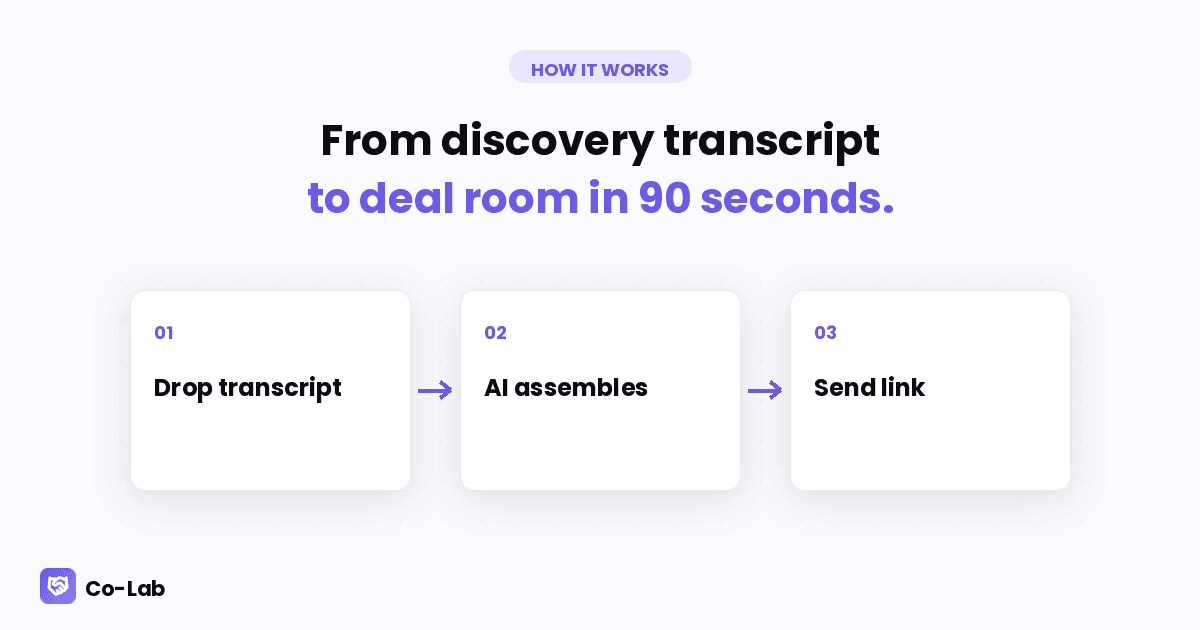
The 90-second pipeline
Drop the transcript — Paste the discovery call transcript (from Gong, Zoom, Granola, Otter, anywhere). No formatting required.
AI extracts signals — In ~10 seconds, the model identifies who said what, what pain points came up, what the buyer's stated timeline is, what objections surfaced, who else needs to be involved.
AI assembles the deal room — The signals get matched to a pod template. Hero block populated with buyer-specific copy. Asset block populated with the relevant case study. Mutual action plan auto-drafted from the verbal commitments on the call. Pricing block populated with the tier discussed.
Send the link — One URL goes to the buyer. They open it on their phone in the car. The deal moves forward.
Total elapsed time: 90 seconds. Total elapsed AE effort: paste + click.
What this changes for the AE
The thing that's actually different isn't the time saved. It's when the artifact lands in the buyer's hands.
Old workflow: discovery call ends Tuesday at 11am. Follow-up email sent Wednesday afternoon (because the AE had 3 more calls after). Buyer reads email Thursday morning. Buyer forgets half the call by then. Deal slows.
New workflow: discovery call ends Tuesday at 11am. AE drops the transcript at 11:05am. Pod link is in buyer's inbox at 11:07am. Buyer opens it during their lunch — same day, same memory. Deal moves.
That gap — from "follow-up tomorrow" to "follow-up before they leave the parking lot" — compresses sales cycles measurably. Pilot data we've collected: deals where the pod ships within 30 minutes of the call close roughly 22% faster than deals where the follow-up arrives the next day.
What the AI gets right (and what it doesn't)
Right:
- Identifying the named pain points
- Pulling the named timeline
- Naming the next step
- Pulling the right asset from your library
- Drafting the welcome copy in your buyer's voice
Imperfect:
- Subtle objections (sarcasm, hesitation in voice — transcripts don't capture tone)
- Implicit competitive positioning ("we're also looking at X" without saying X)
- The relationship dynamics ("I think Sarah is the real decision-maker, not the title-holder")
So: AI ships the pod 80% of the way. The AE customizes the last 20% — adjusts the copy, swaps an asset, adds a personalized note. That last 20% is where the AE's judgment shows. The first 80% is the part that used to take 4 hours.
The objection: "But the buyer can tell it's AI-generated"
This was true in 2023. It's mostly not true now if the AE does the last 20%.
The pod isn't a sales artifact in the way a deck is. It's a personalized space the buyer enters. The AI generates the structure and the first-draft content. The AE personalizes — names, specific quotes from the call, the verbal commitments made. By the time the buyer sees it, the AI part is invisible.
What's visible: a pod that references things the buyer specifically said on the call. That doesn't read as AI. That reads as attention.
Where this falls apart
Two failure modes worth naming:
The transcript is bad. Garbled audio, multiple speakers talking over each other, low-confidence transcription. AI can only work with what it can read. A bad transcript produces a bad first-draft pod.
The AE skips the 20%. The pod ships untouched. The buyer notices. The pod looks generic. The deal doesn't accelerate.
Both are operational, not technical. Fix the transcript pipeline. Make the 20% review a non-skippable part of the workflow.
What this means for your team
If your AEs are spending 4+ hours per discovery call on follow-up artifacts, you have a 70% time recovery sitting on the table. Not a 20% productivity bump — a complete category change.
The shift isn't "AI helps the AE write faster." It's "AI ships the artifact while the AE is still in the next call." That timing change is what compresses your sales cycle.
The technology is there. The remaining work is changing the team's habits to match it.
Want to see what a transcript-built deal room looks like? Try Co-Lab free at colabapp.ai. Use code SALES at signup for 3 months on us.
More from the blog
Keep reading.
The Limits of AI in B2B Sales (And Where Humans Still Win)
An honest list of jobs not worth automating yet — from someone who builds AI sales tools.
Why AI "Wrappers" Are Beating Custom-Built Sales Tools
The contrarian case for buying the boring product on top of GPT-4 over building your own.
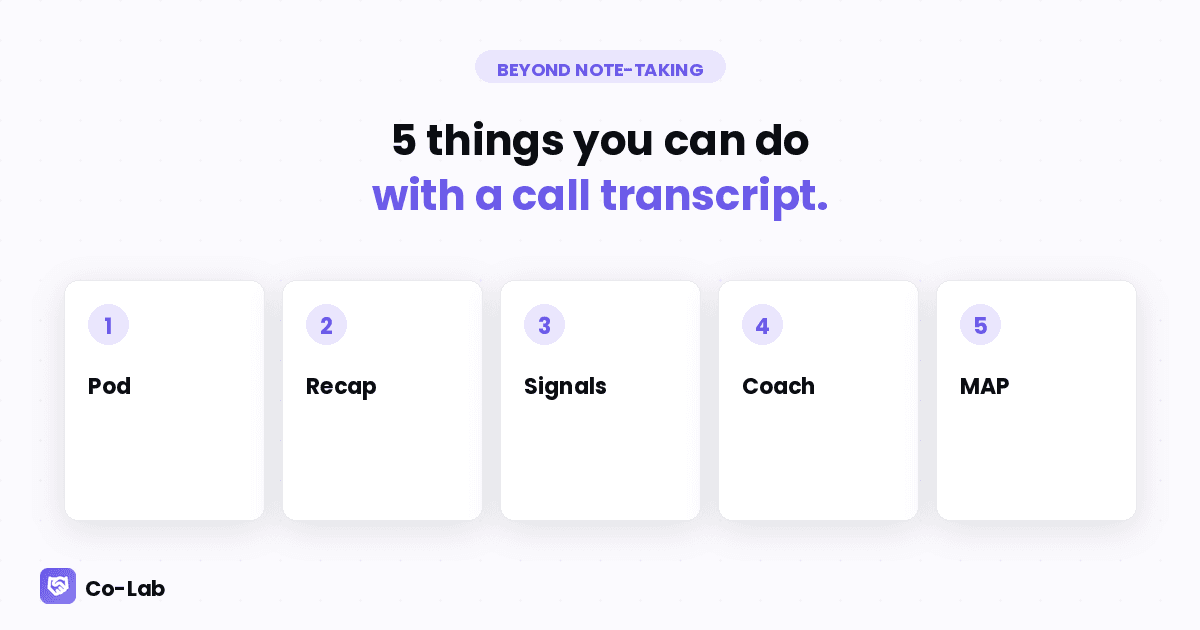
5 Things You Can Do With a Sales Call Transcript Beyond Note-Taking
The transcript is the most underused asset in your sales workflow. Here's how to extract real leverage from it.