What Is a Digital Sales Room? (And Why Your Deck Isn't One)
The category, the confusion, and what actually distinguishes a deal room from the things you've been calling deal rooms.
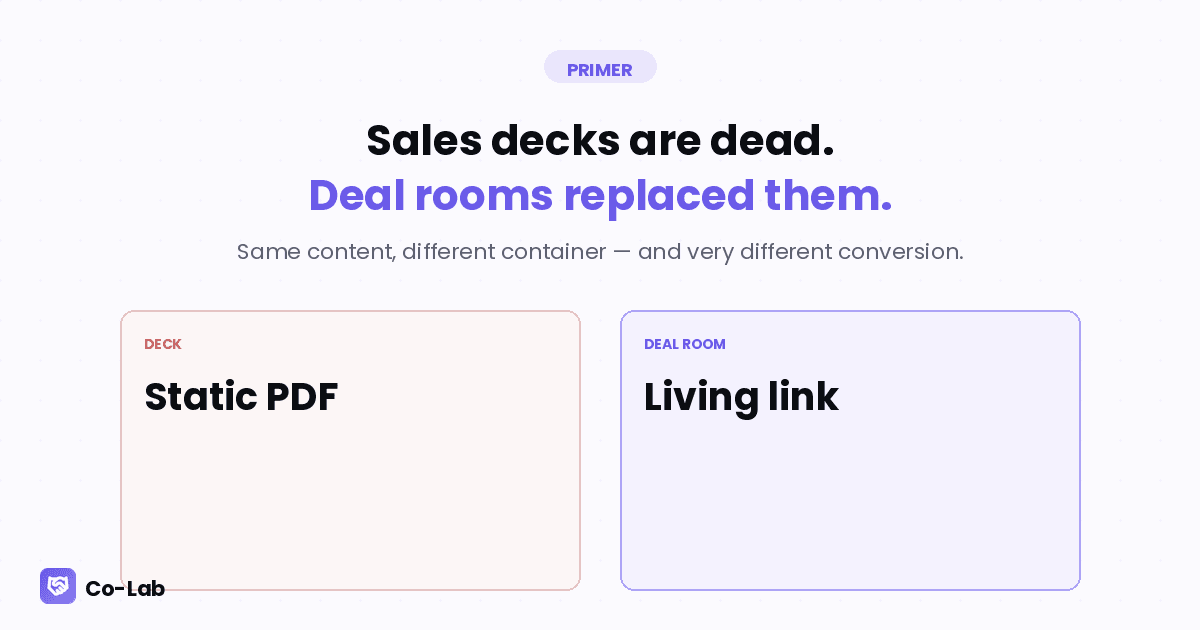
The phrase "digital sales room" is doing a lot of work in B2B sales right now. Vendors use it to describe everything from PDF portals to Notion pages to attached Loom links. The category is real. The definition is muddy.
Here's the actual definition, why it matters, and what it's not.
The minimum viable definition
A digital sales room (or deal room, or pod if you're using Co-Lab's vocabulary) is:
A persistent, shareable URL that contains every artifact relevant to a specific deal, updates in real time, and tracks who in the buyer's organization opened what.
Three things make it a deal room and not just a folder:
- Persistent URL — One link the buyer keeps coming back to
- Real-time updates — Changes you make are reflected for the buyer instantly
- Engagement tracking — You can see what they viewed, when, and how long
If your "sales room" is missing any of those three, it's not a deal room. It's a folder with a URL.
What it's not
A sales deck — Static, sent once, immediately outdated, no tracking.
A Notion page you shared — Persistent and updated, but no engagement signal. You don't know if anyone opened it.
A Google Drive folder — Same problem as Notion plus the additional friction of "does this person have access?"
A DocSend link — Closer — DocSend tracks opens. But it's per-document. You're back to sending 5 DocSend links per deal, which defeats the point.
A Loom playlist — Personal touch, but one-way. The buyer can't add anything, can't ask questions inline, can't loop in their team meaningfully.
A "deal room" feature in your CRM — Often this is just a tagged folder. Check whether the buyer can actually open it without logging into your CRM. Usually not.
Why the category exists now (and didn't 5 years ago)
Three things had to happen:
Buyers got pickier about how content arrived. The "send me everything" model used to work. Now buyers expect a curated, navigable experience.
Tracking became expected. Buyers know you're tracking opens (they read the blog post you wrote). Sellers know they should be. The arms race moved from "are we tracking?" to "what are we tracking?"
AI made the artifacts cheap to build. Custom-branded deal rooms used to take 2 hours of design time. Now they take 90 seconds from a transcript. The economics flipped — every deal can have one.
The deal room category isn't new. It's just newly cheap enough to be worth building per deal.
What changes when you actually use one
The buyer-side experience changes more than the seller-side does:
Before: "I have your stuff in 4 emails, 2 attachments, and a Loom link. Where's the pricing again?"
After: "Open the link. The pricing is in the third tab."
Before: "Let me forward you these 6 things from the AE's last email."
After: "Here's the link the AE sent. Look at the 'Plan' tab for the timeline."
The deal room becomes the single artifact your champion forwards internally. That's where most of the value is — making your champion's job of selling internally easier than it would be without you.
The seller-side metrics that change
Time-to-respond on follow-ups. With everything in one place, follow-ups stop being "let me dig out that pricing PDF." They become "yeah, that's in the pod, click here."
Multi-threading rate. When the deal room is one link, your champion forwards it to their CFO. The CFO opens it. You see them open it. Now you know to email the CFO.
Stalled-deal recovery. When activity goes quiet, you can see where it went quiet — the buyer opened the integration page, didn't open the pricing page. That tells you what to send next.
Close-to-handoff. When CS picks up the account, the deal room is the artifact. Everything that was sold is documented in one URL. Onboarding is faster because there's no "what did sales tell them?"
The honest objection
"This is just a more polished version of an email thread."
Partly true. The differences that matter:
- Persistence. An email gets buried. A deal room URL stays at the top of mind because the buyer keeps opening it.
- Forwardability. "Forward this email" requires the buyer to recapitulate context. "Forward this link" doesn't.
- Update-ability. When pricing changes, the buyer's view changes. No "ignore the previous email" addendum.
- Visibility. You see who opened what. Email gives you opens, maybe. Deal rooms give you opens plus dwell time plus navigation behavior.
These differences compound across a quarter. Teams that switch don't go back.
What this means for your team
If your sales process still ends a discovery call with "I'll send you a follow-up email with everything we discussed," you're operating in 2018.
The 2026 version is "I'll send you a deal room link in the next 5 minutes." It's a small change to say. It's a meaningful change to the conversion math underneath.
Want to see what a deal room actually looks like? Co-Lab generates one from any sales call transcript in 90 seconds. Free at colabapp.ai, code SALES for 3 months on us.
More from the blog
Keep reading.
The Death of the Email-Deck-Loom-Spreadsheet Cycle
Why the standard B2B sales follow-up is the worst buyer experience in software, and what's replacing it.
How to Close a Deal Without Another Sync Call
Three deal-room patterns that move late-stage deals while you sleep.
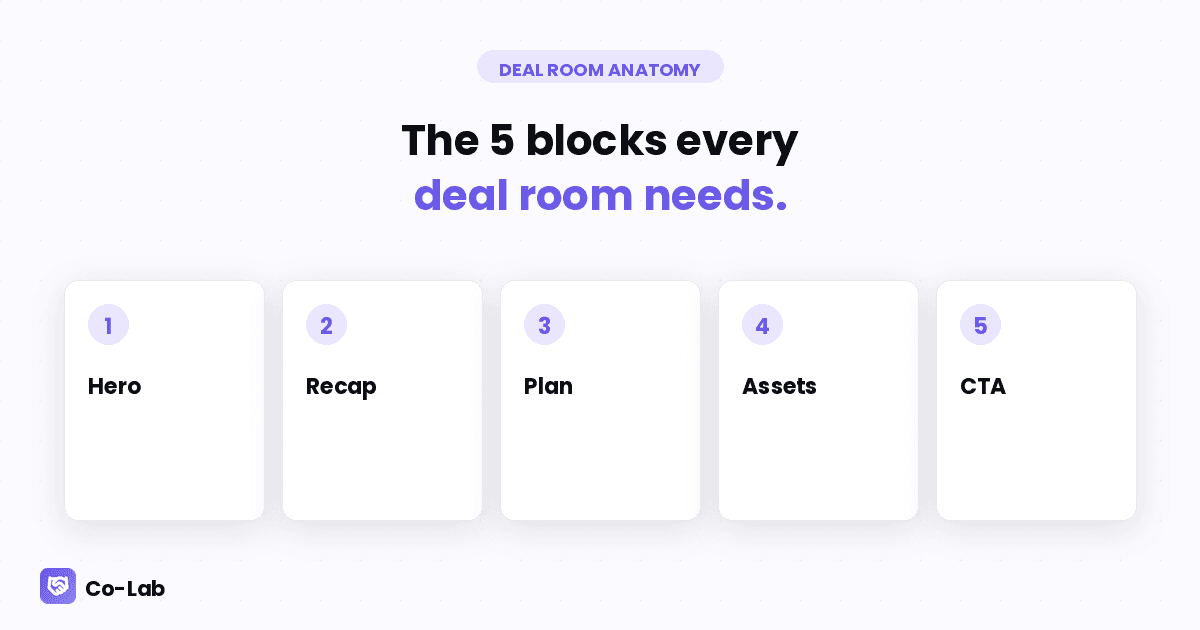
The 5 Blocks Every Deal Room Needs (And the 9 You Don't)
A minimum-viable structure for buyer-facing deal rooms — and the blocks teams add that don't move the needle.