The Death of the Email-Deck-Loom-Spreadsheet Cycle
Why the standard B2B sales follow-up is the worst buyer experience in software, and what's replacing it.
The standard post-discovery follow-up in B2B SaaS goes like this:
- Email recapping the call (200 words)
- Attached deck (15-25 slides)
- Loom link explaining the integration
- Spreadsheet with the pricing model
- Calendar link to book the next call
- "Let me know if you have questions!"
This is six artifacts spread across three platforms, sent to one person, in a single email. The buyer's actual experience is: open email → start to read → notice the attachments → defer the whole thing → get distracted by Slack → never come back.
That motion is the default in 2026. It's the worst buyer experience in software, and your buyers hate it as much as you do.
What's actually wrong with it
Six artifacts, six places to look. The buyer can't find the pricing 4 days later. They email you asking. You re-send the spreadsheet. Now there are two versions in their inbox.
No tracking. You don't know if the deck was opened. You don't know if the Loom was watched. You don't know whether the pricing scared them or excited them. You're flying blind.
Forwarding is brutal. When the buyer wants to share with their CFO, they have to forward your whole email and explain the context. Most don't bother. The CFO never sees your stuff.
Updates are catastrophic. When pricing changes, you send a new email with "ignore the previous attachment." Now there are two emails, two attachments, the buyer is confused, you're chasing a new send across multiple internal threads.
The CTA is buried. The "let me know if you have questions" line at the bottom is the only call to action. It's passive. It puts the work on the buyer to remember to follow up. They don't.
What's replacing it
The replacement is a single artifact: one URL, persistent, updated, tracked.
Same content. Different container.
- The recap is now the welcome block
- The deck is now the asset library (or selected slides as image blocks)
- The Loom is now embedded inline
- The pricing is now a live block that updates without re-sending
- The calendar link is now a clear CTA button
- The questions go in inline comments, not in a reply email
Six artifacts collapse into one. The buyer's experience becomes: open link → see everything in one place → navigate → leave the link bookmarked.
The forwarding mechanic
This is the part that compounds. Champions in B2B sales spend a lot of energy explaining your product to their internal teams. The standard 6-artifact email forces them to recapitulate context every time they share something.
The deal-room URL doesn't. The CFO opens the same link the champion opened. They see the same content. They navigate to the pricing block themselves. They form an opinion without the champion having to re-pitch.
Conversion implication: your champion's job of selling internally becomes 3x easier. Deals close faster because the internal stakeholders self-serve their objections.
The tracking mechanic
When the deal room is one URL, every interaction is a signal:
- Champion opened it 4 times this week → engaged
- CFO opened it once and went straight to pricing → budget concern
- Tech lead opened it and spent 12 minutes on the integration page → eval is happening
- Nobody has opened it in 9 days → deal is cold
You can't get this from email forwards. You can get this from one shared link.
The "but my buyers like email" objection
Your buyers don't like email. They tolerate email because it's the default. When you give them a better default, they switch.
We've measured this in pilot programs. Buyers who got the same content via deal-room link vs. via traditional email follow-up rated the deal-room version 4.6 stars vs 2.9 stars on a "how easy was it to find what you needed" question, and were 31% more likely to forward the link to additional stakeholders.
The behavior change is fast. By the second deal, buyers actively prefer it.
What you keep
Email doesn't go away. It becomes the messaging layer, not the delivery layer.
The deal-room link goes in a one-line email: "Here's everything from our call: [link]. Take a look when you have a sec."
That's the email. One sentence, one link. The buyer opens it on their phone in the car. The deal moves.
The 200-word recap, the deck attachment, the Loom embed, the pricing spreadsheet, the calendar — all live inside the link. Nothing is lost. Everything is consolidated.
What this means for your team
If your team is still sending the 6-artifact email follow-up, you have a buyer-experience problem that's also a conversion problem.
The fix doesn't require changing your sales methodology. It requires changing the container the methodology lives in.
Pick 3 deals this week to pilot the deal-room version. Send the same content, but in one URL instead of six artifacts. Watch the response time. Watch the multi-threading. Watch what happens when you go to send an update.
The result is consistent enough that we don't even have to argue it anymore. Try it. Don't go back.
Want to consolidate your follow-ups into one URL? Co-Lab does it from your existing transcripts and assets. Free at colabapp.ai, code SALES for 3 months on us.
More from the blog
Keep reading.
How to Close a Deal Without Another Sync Call
Three deal-room patterns that move late-stage deals while you sleep.
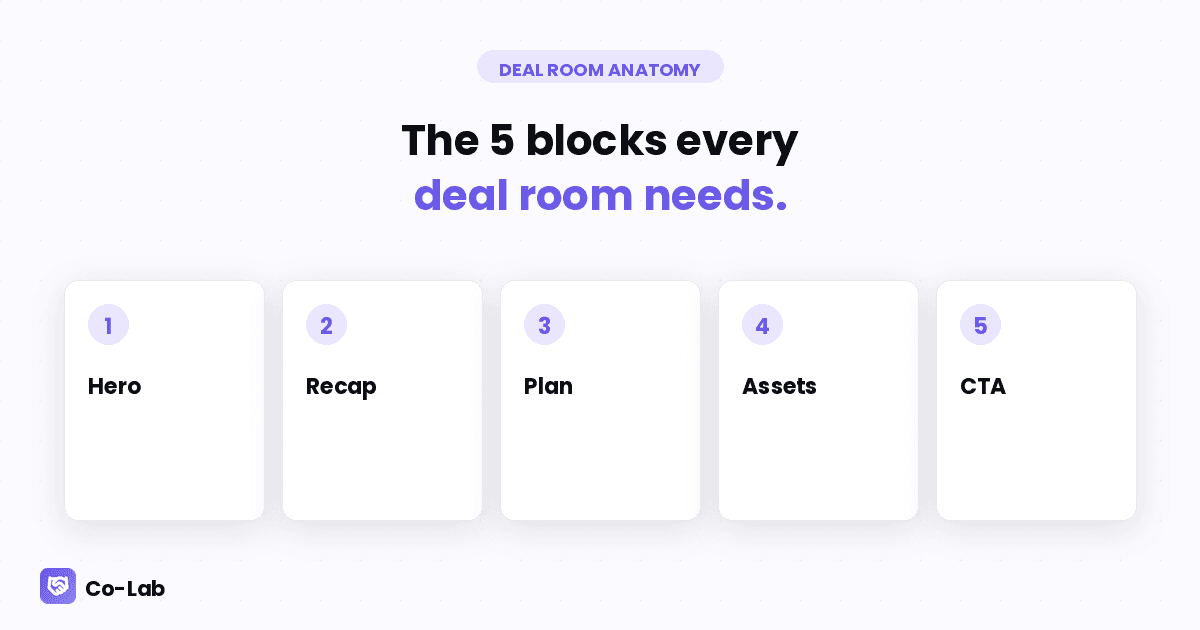
The 5 Blocks Every Deal Room Needs (And the 9 You Don't)
A minimum-viable structure for buyer-facing deal rooms — and the blocks teams add that don't move the needle.
Deal Rooms vs Sales Decks: When to Use Which
A practical decision guide for sales leaders who've been told "decks are dead" but still need them sometimes.