5 Things You Can Do With a Sales Call Transcript Beyond Note-Taking
The transcript is the most underused asset in your sales workflow. Here's how to extract real leverage from it.
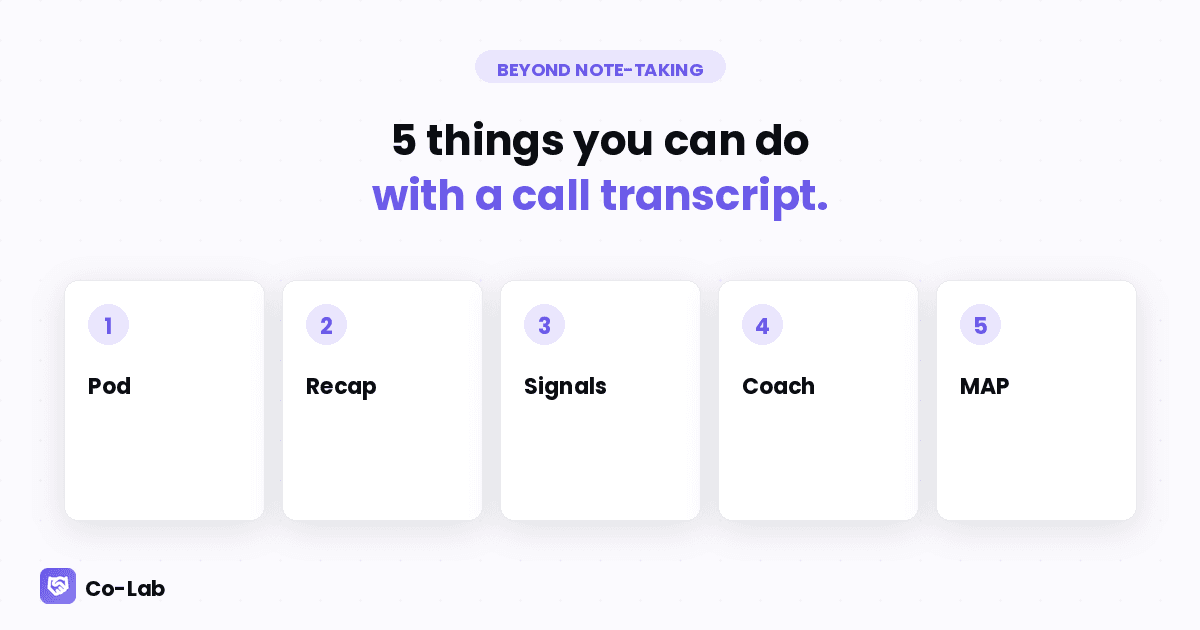
If you record sales calls, you're probably using ~5% of the transcript's value. The standard workflow is: record → auto-transcribe → AI generates a summary → summary goes into the CRM → nobody reads it again.
The transcript is content. It's the most concentrated source of buyer intent your team will ever capture, and most of it sits in a database doing nothing.
Here are five higher-leverage uses for the same transcript.
1. Generate the deal room
The transcript is everything you need to build a personalized deal room: the buyer's stated pain, their named timeline, their decision-makers, the pricing they reacted to, the objections they surfaced.
Drop the transcript into a tool that generates a pod from it (we obviously think Co-Lab does this best, but the category is real beyond just us), and you have a buyer-facing artifact within minutes of the call ending.
The artifact lands in the buyer's hand while the call is still fresh. That timing is the leverage.
2. Extract the verbatim language for the recap email
The mistake most AEs make in follow-up emails: they use their language to summarize the call.
The buyer doesn't read their own pain points back the way you wrote them. They read them the way they said them.
Pull the transcript. Find the moment the buyer said "we're spending 2 hours every Friday on this" and quote that line back to them in the recap. The email lands differently when it sounds like you actually listened.
The mechanic: reps who quote 1-2 verbatim phrases from the call get measurably higher reply rates on follow-up emails. Pattern holds across hundreds of cases.
3. Surface signals you missed in the moment
You're listening on the call. You're processing in real time. You miss things — small hesitations, contradictions, off-hand comments that turn out to matter.
The transcript catches them. A good post-call AI scan will surface:
- "Buyer mentioned a competing tool 3 times — you only acknowledged it once"
- "Buyer's CFO was named twice but you didn't ask about the budget approval process"
- "Buyer said 'flexibility' 5 times — that's their priority, not the feature you talked about for 10 minutes"
These are coaching insights you'd otherwise need a sales manager to surface in a call review. AI can do it within the hour.
4. Auto-draft the mutual action plan
The MAP is the deal artifact most likely to never get written. Every methodology insists on it. Most AEs skip it because it's a 30-minute drafting task they don't have time for.
The transcript already contains the MAP. Every "we'd want to start by Q2" or "we'd need to loop in legal first" or "let me run this past the team and circle back" is a MAP step. AI can extract them and ship a first-draft plan in seconds.
The AE's job becomes editing the draft — adding dates, assigning names — instead of building from scratch. That's a 90% time reduction on the artifact most AEs skip entirely.
5. Feed the coaching loop
Every sales team trains on "what good looks like." Most teams use the same 3 calls for every new hire because building a fresh library is too much work.
A transcript library — searchable by deal stage, objection type, competitor mentioned — is a training resource you build automatically by recording calls. New hires can search "calls where the buyer raised the price objection" and listen to the 8 best examples in their first week. Ramp time drops because the training material is your own real deals.
This works at any team size, but the leverage is biggest at small teams. A 5-AE team with a great transcript library out-trains a 50-AE team with 3 hand-picked example calls.
The meta-pattern
Notice the common thread across all five: the transcript is raw input. The leverage is in what you do with it. Note-taking treats the transcript as the output. Treating it as input opens up everything else.
The teams treating transcripts as content (not as records) are getting compounding returns. The teams treating them as the artifact at the end are paying for transcription and getting a CRM update out of it.
What this means for your team
If you're already recording calls (which you probably should be, with consent), the marginal cost of these 5 use cases is near zero. The infrastructure is already paid for. The transcripts are already being generated. The leverage is just sitting there.
Pick one of the five to operationalize this quarter. Probably #1 (deal room) if you're early-stage selling, or #5 (coaching library) if you're scaling a team. The others come later.
Want the deal-room version? Co-Lab generates pods directly from your call transcripts. Free at colabapp.ai, code SALES for 3 months on us.
More from the blog
Keep reading.
The Limits of AI in B2B Sales (And Where Humans Still Win)
An honest list of jobs not worth automating yet — from someone who builds AI sales tools.
Why AI "Wrappers" Are Beating Custom-Built Sales Tools
The contrarian case for buying the boring product on top of GPT-4 over building your own.
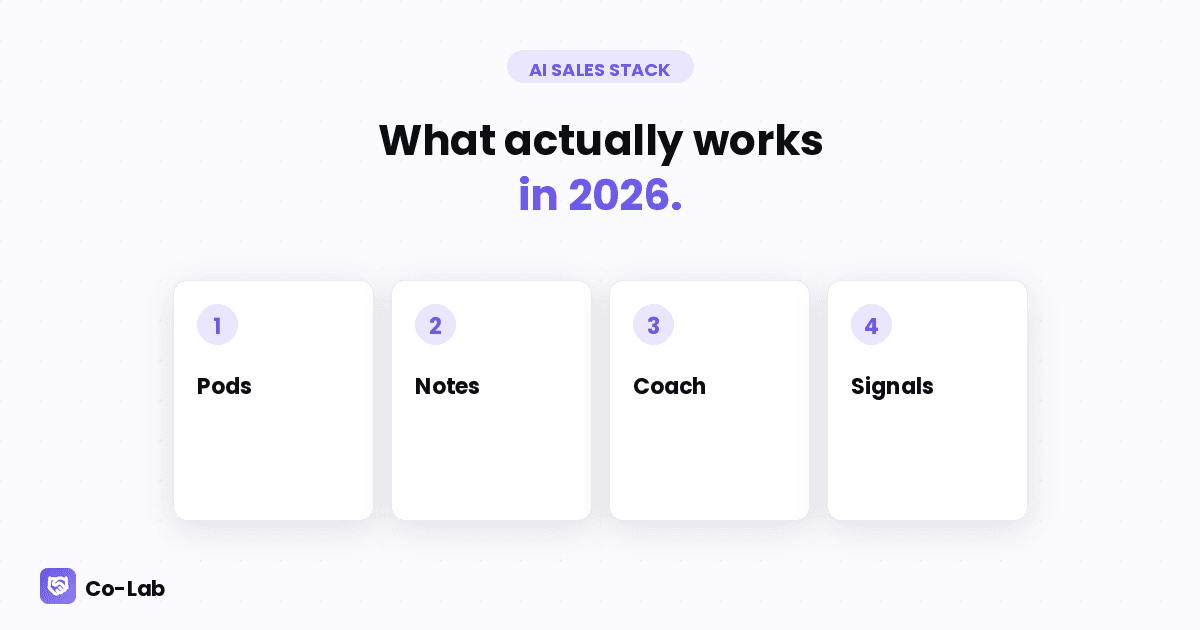
The AI Sales Stack in 2026: What Actually Works
Cutting through the 200+ "AI sales tools" pitches landing in your inbox to the four categories that move pipeline.