Reading Buyer Activity Like a Forecast
A practical scoring framework for turning engagement data into deal-state insight.
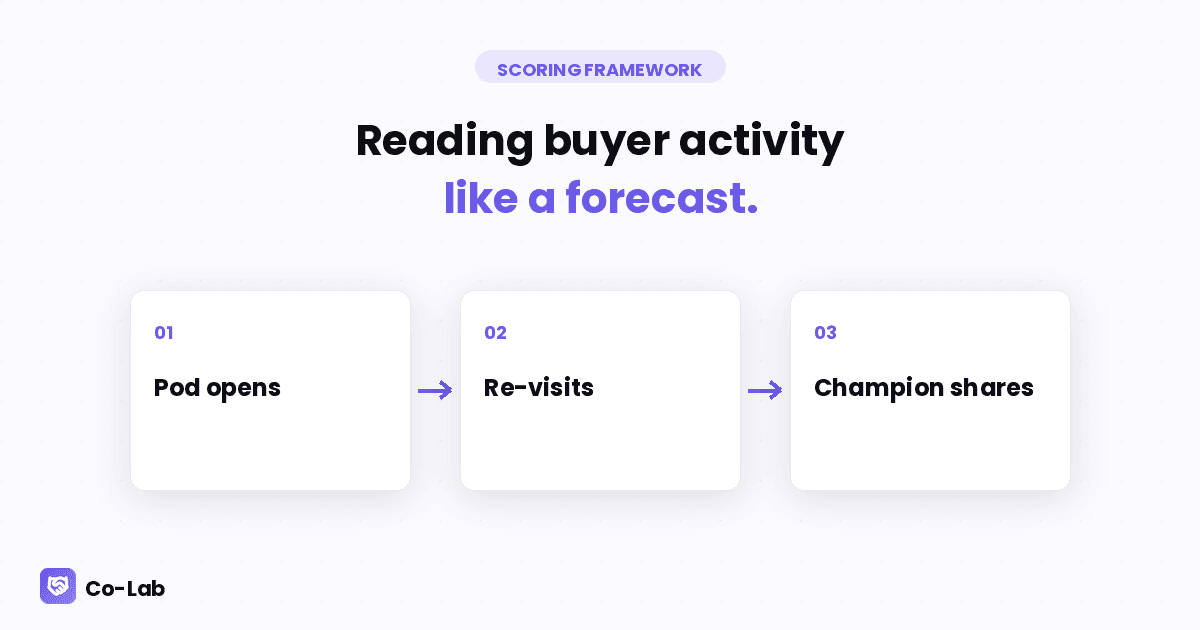
Most engagement tools surface raw events: opens, clicks, time on page. They don't tell you what the events mean.
A deal with 47 events isn't necessarily a hotter deal than one with 12 events. The shape of the activity matters more than the volume. Here's a simple framework for reading it.
The three-axis score
Every active deal gets scored on three axes:
Recency. When was the last meaningful buyer interaction? Today: fresh. This week: warm. Last week: cooling. Two+ weeks ago: cold.
Spread. How many distinct stakeholders engaged? One: champion-only. Two: champion + reviewer. Three+: real internal motion.
Depth. Are interactions surface-level (skim opens) or deep (long dwell, re-visits, downloads)? Surface = curiosity. Depth = decision-making.
Plot every deal on these three. The patterns are obvious within a week of doing it.
The four states each deal falls into
Hot: Recent + Spread + Deep. Multiple stakeholders engaging deeply, recent activity. Move it forward aggressively.
Building: Recent + Spread but not yet Deep. New stakeholders coming in but skimming. Their next action determines everything — escalate to a relationship-building call.
Champion-only: Recent + Deep but no Spread. Your champion engages a lot, no one else does. They believe; they haven't sold internally. Help them sell internally.
Cold: Not Recent. Nothing else matters once the deal goes silent for 10+ days. Re-engage or kill.
That's the entire framework. Four states, three axes. You can run a pipeline review in 15 minutes once you've classified everything.
What changes when you score this way
The most common mistake in pipeline reviews: treating "high activity" as "high intent." It often isn't. A champion who opened the deal room 8 times this week is interested, but if no one else has opened it, the deal is single-threaded and at risk.
The score above catches this. A champion-only deal looks high on engagement volume but classifies correctly as "champion-only" — meaning the work is internal selling, not closing.
Conversely: a deal with low recent activity but high historical depth (multiple stakeholders all engaged a month ago, then silence) classifies as "cold" — meaning the deal stalled and you missed it. The traditional CRM lens would have shown this deal as "healthy" because the AE marked the stage as "negotiation" three weeks ago.
How to operationalize without a tool
If you have an engagement-tracking tool (Co-Lab, DocSend, etc.), most of this is built in or trivial to script.
If you don't:
- Recency: track the date of every buyer email reply or document open. Last buyer-side action date = recency score.
- Spread: count distinct email addresses or names that have interacted with your deal artifacts in the past 14 days.
- Depth: subjective grade — did your last 3 buyer-side interactions include substantive questions or just acknowledgments?
A spreadsheet with three columns per deal is enough to start. Don't over-engineer it.
The forecast accuracy lift
When sales teams add this scoring layer to their pipeline review:
- Hot deals close at higher rates than the rep's "commit" calls (because the data corroborates intent the rep felt but couldn't articulate)
- Champion-only deals close at the rate of "best case" forecasts (because they're at internal-selling risk that the rep often underweights)
- Cold deals previously labeled "best case" or "commit" tend to drop to "lost" (because the rep was forecasting based on stage advancement, not buyer behavior)
Net effect: forecast accuracy at the rep level improves measurably within a quarter. The improvement comes from removing the deals that looked live but were actually dead.
The hardest discipline: killing cold deals
The framework's biggest payoff is also the hardest behavior change: marking cold deals as cold.
Reps don't want to do this. A "negotiation"-stage deal that's been silent for 14 days is psychologically protected — the rep talked themselves into believing it's still real. The classification system forces the question.
Sales leaders should treat the "cold" classification as an action trigger, not a death sentence. Every cold deal gets one explicit re-engagement attempt. If it doesn't respond, mark it lost. Move on. The pipeline becomes 30-40% smaller and 2-3x more accurate.
What this means for your team
You don't need a new tool to start. You need a 15-minute weekly pipeline review where every active deal gets classified into one of the four states.
Within four weeks, your team will have a shared language for talking about deal state that isn't just "where is it in the funnel." They'll be talking about what the buyer is doing, not what the AE did last.
That language change is the real shift. Tooling makes it easier. Discipline makes it work.
Want engagement scoring built in? Co-Lab classifies every deal automatically using these axes. Free at colabapp.ai, code SALES for 3 months.
More from the blog
Keep reading.
Stalled Deals: 6 Engagement Signals You Missed Before It Went Cold
The signals that show up 7-14 days before a deal officially stalls — and what to do when you see them.
Champion Vetting: How to Tell If Your Internal Advocate Is Real
Four signals that distinguish a real champion from a friendly contact who's about to ghost you.
Why Your CRM Misses 80% of the Buyer Journey
The signals living outside Salesforce that predict deals better than anything in it.