The 2026 Sales Tools Audit: What to Cut, What to Keep
An honest framework for trimming a sales stack that's grown to 18 tools nobody fully uses.
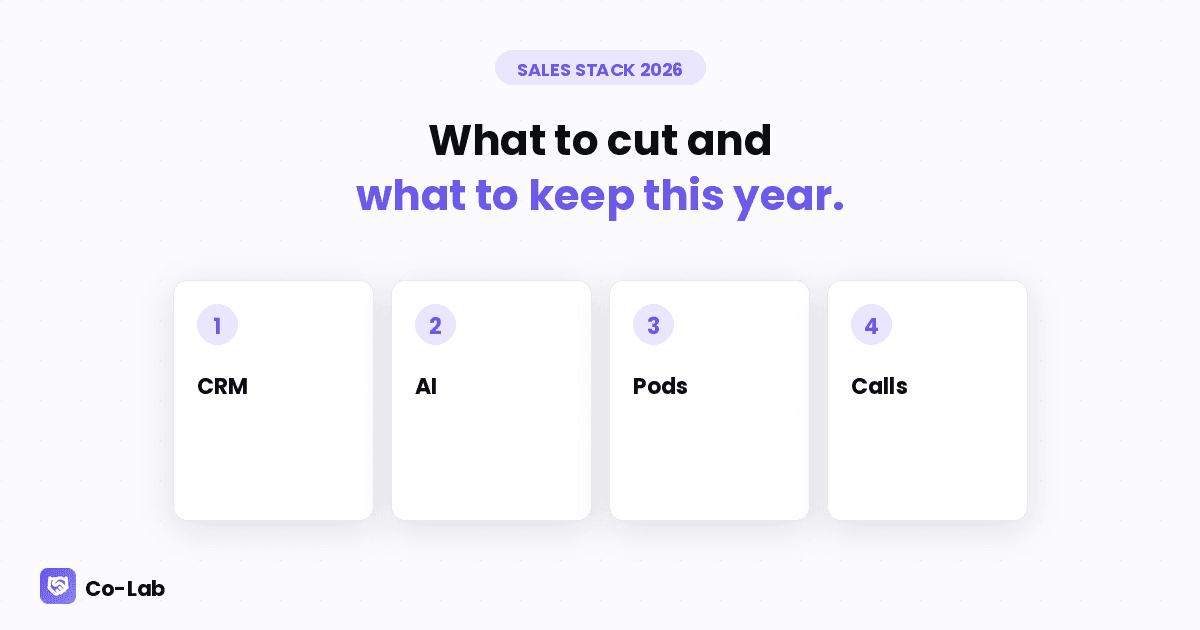
The average B2B SaaS sales team's tooling stack has grown 4-6x in the past 5 years. Each tool was added to solve a specific problem. None of them got removed when the problem evolved.
The result: a stack of 15-25 tools per AE, monthly cost in the high four figures per seat, and reps using maybe 30% of the features they're paying for.
Here's a practical audit framework for cutting.
The 4 categories every sales stack actually needs
After reviewing tooling stacks across 50+ teams, the categories that show up everywhere:
1. CRM (Salesforce, HubSpot, Pipedrive) Pipeline of record. Where deals live. Where forecasts come from.
2. Communication (email tool, calendar tool, video tool) How AEs reach buyers. Often Gmail/Outlook + Calendly + Zoom.
3. Conversation intelligence + artifact production (Gong, Co-Lab, Apollo, etc.) Records calls, generates follow-ups, ships deal rooms.
4. Engagement tracking (DocSend, Co-Lab, ON24) Who opened what, who's hot, who's cold.
Note: categories 3 and 4 are often combined in one tool (Co-Lab covers both). When that's true, the stack is leaner.
Categories most teams over-invest in
Sales engagement / sequencing tools (Outreach, Salesloft)
These were the high-growth category of 2018-2022. They're still useful — but most teams have grown past needing them. Modern tools (Gmail-native scheduling, AI-drafted outreach, CRM-embedded sequencing) absorb their core function for less cost.
If your team is paying $150/seat/mo for an outreach tool primarily to send sequences, audit whether 80% of the value would be captured by simpler alternatives at $30/seat.
Lead enrichment tools (ZoomInfo, Apollo, Lusha, Cognism)
Many teams pay for 2-3 of these because each was bought for a specific use case. They overlap heavily. Pick one. Cut the others.
Sales coaching tools (Chorus, Gong's coaching layer, etc.)
Useful in theory. Used in practice mostly for "search the call recording" — a feature that doesn't justify the standalone tool's price for teams under 50 reps.
Contract management tools (DocuSign, Ironclad, etc.)
Necessary for one purpose: get contracts signed. Often over-bought when teams pay enterprise tier for what could be a simpler signing tool. Audit whether you're using the workflow features or just the signature collection.
"AI" sales tools without a clear category
Tools that pitch "AI for sales" without fitting cleanly into one of the four core categories above. Usually feature noise. If a vendor can't tell you which category they replace, they're an addition, not a substitution. Cut.
Categories most teams under-invest in
Pipeline visualization beyond the CRM default
Most teams use whatever pipeline view their CRM ships with. The default views are often bad. A good third-party pipeline tool (or a well-built CRM custom view) saves leadership 2-3 hours per week. Worth the investment.
Async video (Loom, Vidyard)
Underused for the value. A 90-second async video replaces a 15-minute sync call. The cost is low ($25-40/seat). The lift on deal-cycle compression is meaningful.
Buyer-facing artifact tools (deal rooms, pods)
Most teams haven't bought into this category yet. The ones that have see the engagement-tracking + artifact-production combination as their highest-leverage tool.
The audit framework
Run this on your stack quarterly:
Step 1: List every tool, the per-seat cost, and the category it falls into.
You'll likely find 2-3 tools in the same category. That's your first cut candidate.
Step 2: For each tool, list the 3 features your team actually uses.
If you can't think of 3 features, you're paying for a tool nobody uses. Cut.
Step 3: For each tool, identify what would happen if you turned it off tomorrow.
If the answer is "we'd be inconvenienced for a week, then find a workaround," cut. If the answer is "deals would stop closing," keep.
Step 4: For each kept tool, check if a competitor in the same category is meaningfully cheaper.
The pricing in B2B SaaS sales tools has compressed dramatically. Tools you bought in 2020 at $200/seat may have $80/seat alternatives now with the same features.
What 2026 stacks actually look like
A lean, modern sales stack (post-audit):
| Category | Tool | Per-seat cost |
|---|---|---|
| CRM | HubSpot Sales / Salesforce | $50-150/mo |
| Communication | Gmail/Outlook + Calendly | Bundled |
| Conversation intelligence | Gong or Granola | $80-150/mo |
| Artifact + engagement | Co-Lab (or similar) | $35-55/mo |
| Lead enrichment | One choice (Apollo, ZoomInfo) | $50-100/mo |
| Async video | Loom | $25/mo |
Total: $240-480/seat/month
Compared to typical 18-tool stacks at $700-1200/seat. A serious team can cut 50-60% of stack cost with no functional loss.
The cultural friction
Cutting tools is harder than buying them. Three sources of resistance:
1. Switching cost. "We just trained the team on this." True. The training cost is sunk; the ongoing license cost isn't. Cut anyway if the tool isn't earning its keep.
2. The single rep who loves it. There's always one rep who uses tool X heavily. Talk to them. Often the workflow they value can be replicated in a tool you're already paying for.
3. The vendor's exit objections. Vendors will offer discounts, customer success rescue plans, "let's not throw out the baby with the bathwater" calls. Politely decline. The audit was the decision; the discounts don't change the math.
What this means for your team
Run the audit this quarter. If you've never done it, the first audit will surface 4-6 tools you can cut without functional loss. That's $40K-100K of annual savings on a 20-person team.
Reinvest the savings in the tools you should be using more — usually the engagement-tracking and artifact-production category that most teams under-invest in.
The goal isn't a smaller stack. It's a more deeply used stack. Reps using 4 tools well close more than reps using 18 tools poorly.
Want a tool that combines artifact production + engagement tracking? Co-Lab does both. Free at colabapp.ai, code SALES for 3 months.
More from the blog
Keep reading.
Where Renewal Risk Actually Hides (Hint: The Handoff)
Why most churn is a handoff problem disguised as a renewal problem — and how to fix it.
Ramp New AEs in 14 Days, Not 90
What changes when your training material is just real pods from real deals.
Forecasting With Engagement Data, Not Just Stage Advancement
Why stage % alone is the worst predictor in your forecast — and what to add instead.